

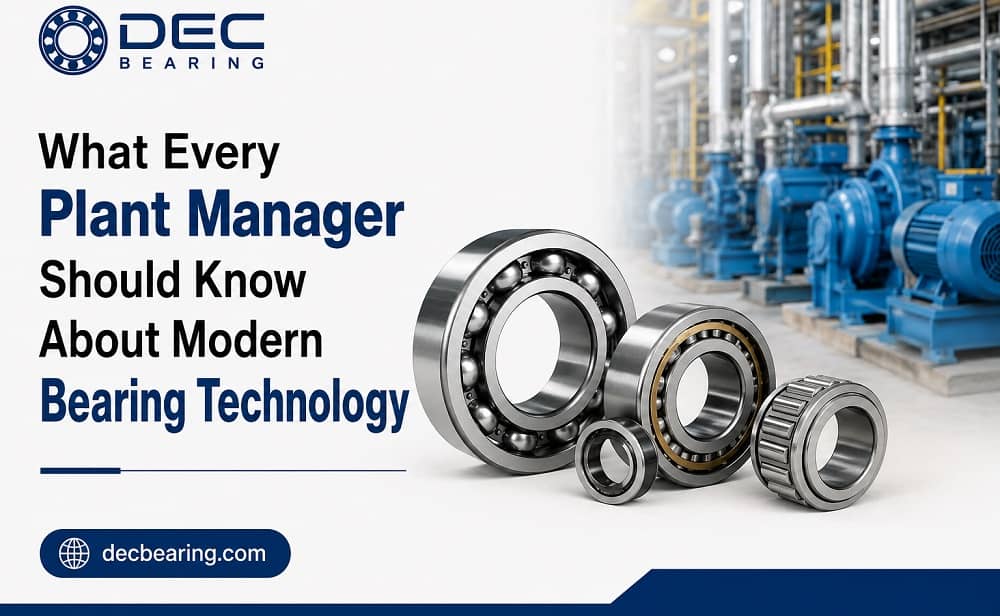
You arrive at the plant in the morning and something feels off. The temperature on the gearbox is up on the higher side. Your operator remarks that the bearing may run hot and soon enough the line is down due to a seized bearing. This is a scenario still too common in plants that continue to treat bearings as commodity parts.
Modern Bearing Technology has graduated from being a commodity item with the introduction of clean steel, optimized roller profiles, improved sealing methods and even condition-monitoring sensors in some cases.
While most of the heavy lifting in industrial equipment still falls to tapered roller bearings manufacturer, they have had a number of changes to the material and construction throughout the years. Steel from which the bearings are made has been improved to reduce the formation of hard spots which lead to stress cracking. Finishing of the raceways have also been optimized to improve motion of the grease film. The rollers have taken on a crowned profile to spread the load and eliminate high pressure areas on the edges. Lastly, improvements to the sealing methods have reduced the risk of contamination without introducing a parasitic drag which would lead to higher bearing temperatures. These improvements fall under the banner of Industrial Bearing Technology and represent a series of small changes which can add up on a 24/7 industrial site.
The Tapered Roller Bearing has a number of characteristic features which allow it to perform its function. The most obvious is the rollers and raceways which are angled at a specific angle. The tapered design allows a bearing to handle thrust loads simultaneously with radial loads. This is done by placing two bearings at an angle facing opposite directions to accommodate thrust in both directions. These bearings see extensive use in the industry due to their ability to handle significant radial loads along with the additional thrust in many machines. Along with the rollers and raceways, the cage is an important part of the bearing. Modern bearings see the majority of their caging made from stamped sheet metal. Some applications require brass or polymer for higher speeds or demanding environments.
When it comes down to the nuts and bolts of the performance, a manager hears the language of operating hours and temperatures. In most cases, the same load capacity on a modern bearing results in lower operating temperatures and therefore longer service life. In terms of service life, improved seals reduce the risk of early failure from contamination in dirty environments. When the bearing is sealed, the interval of grease re-lubrication extends on average across applications. These factors are of direct interest to any plant manager due to the impact of unplanned downtime on the bottom line.
The majority of gearboxes and drives are subject to large radial and thrust loads. The tapered roller bearings handle both without requiring additional sets of bearings to accommodate thrust. The modern improvements to the bearings are especially appreciated on large drives where downtime costs real money. Many plants switching to the updated bearing technology saw benefits in both service life and reduced risk of failures during operation.
Tapered roller bearings are subject to large impacts and stresses during rolling mill operations. Both the cleaner steel and optimized roller profiles reduce the risk of edge stresses causing fatigue failures. The same benefits apply to the sealing methods as the exclusion of water and scale reduce the risks of pitting and other forms of damage.
Conveyors as a class of machinery includes a number of long and complicated drives which require rolling element bearings to handle misalignment and carry the load. The modern bearing technology allows for greater tolerance of shaft misalignment while extended grease intervals reduce maintenance costs. With the combination of these benefits, conveyors see improvements to their overall service intervals.
Pumps and fans represent a significant class of equipment with mixed radial and thrust loads along with moderate speeds. The reduction in friction in the newer designs of tapered roller bearings allows for a decrease in energy consumption on large equipment.
Some plants have the resources to dedicate sensors to the largest and most critical bearings. At a very basic level, most condition monitoring systems only require a vibration sensor and some form of temperature monitoring. More advanced examples introduce acoustic analysis of the bearing sounds with the software analyzing the data to identify developing issues. This is a form of AI in Bearing Technology, though it rarely goes beyond the basic pattern recognition at the high level. The most important aspect of vibration and temperature monitoring is that it takes the guesswork out of predictive maintenance. The systems warn the plant personnel before a bearing is about to seize up, reducing unplanned downtime across the board.
The plants which successfully implement the condition-monitoring solutions see a reduction in emergency bearing jobs and the ability to plan bearing replacements around larger maintenance outages. The technology is becoming cheaper and more accessible with wireless sensors allowing the plant maintenance to watch a few critical bearings without the complexity of laying cables or dedicating a full-time employee to the task.
The everyday benefits of the Modern Bearing Technology include the following:
None of the benefits are artificially generated by manufacturers, all come directly from the improvements to the bearings.
| Factor | Older Designs | Current Tapered Roller | Other Types |
|---|---|---|---|
| Combined radial + thrust | Often needed two bearings | Handles both in one unit | Ball bearings limited on thrust |
| Contamination resistance | Basic seals, frequent failure | Improved seals and flingers | Depends on the design |
| Edge stress under load | Higher, shorter life | Logarithmic profile reduces it | Varies |
| Monitoring options | Mostly manual checks | Sensors + AI analysis available | Same options exist |
| Typical plant use | Still common in older machines | Preferred for heavy mixed loads | High-speed or pure radial jobs |
The selection of a bearing technology in many cases comes down to the specific needs of the application. Below is a guide to selecting the optimal bearing technology based on the conditions and constraints.
If the shaft experiences radial and thrust loads simultaneously, consider a tapered roller bearing as the best long-term solution. If the application calls for very high-speed purely radial loads, an angular-contact ball bearing may be appropriate. Very slow, heavy-duty rollers may use spherical roller bearings, again depending on the combination of load and direction.
Very high temperatures require a high-temperature resistant grease. It is critical to consider both the quality and the quantity of grease used for bearings in such environments as too much grease will also degrade the performance.
Contamination is one of the most significant contributors to bearing failures and should be taken into account when considering the bearing technology and housing design. In many cases, the choice of a bearing is overruled by the choice of a housing due to the requirement for additional protection. The seal of the bearing is frequently the weak point at the weakest link in the chain. It is frequently more cost-effective to invest in improved seal performance to prolong bearing service life.
The value of condition monitoring equipment comes down to the criticality of the application as well as the balance of maintenance expenditures. For critical processes, the cost of an emergency bearing replacement can be much higher than the investment in the monitoring equipment. For lower priority applications, the value analysis may not be as favorable.
Many current tapered roller bearings drop into the same housings as the older ones. That keeps the upgrade simple and the downtime short.
The best bearing technology for industrial applications is the one that matches the load, the dirt, the temperature, and the cost of failure on that specific machine.
Modern Bearing Technology consists of a series of improvements to traditional rolling element bearings. These improvements can be seen in the material selected for manufacturing, geometry of rollers, seal design, re-lubrication intervals and even additional condition-monitoring sensors where it makes economic sense. Due to its ability to handle combined loads while still being able to scale to higher speeds, tapered roller bearings find their way to the center of many critical machines. The plants which continue to think of bearings as commodity items are stuck with the same high labor costs and unplanned downtime. The ones which begin to think of bearings as precision components see a decrease in overall costs and a reduction in expenses associated with overtime work.