

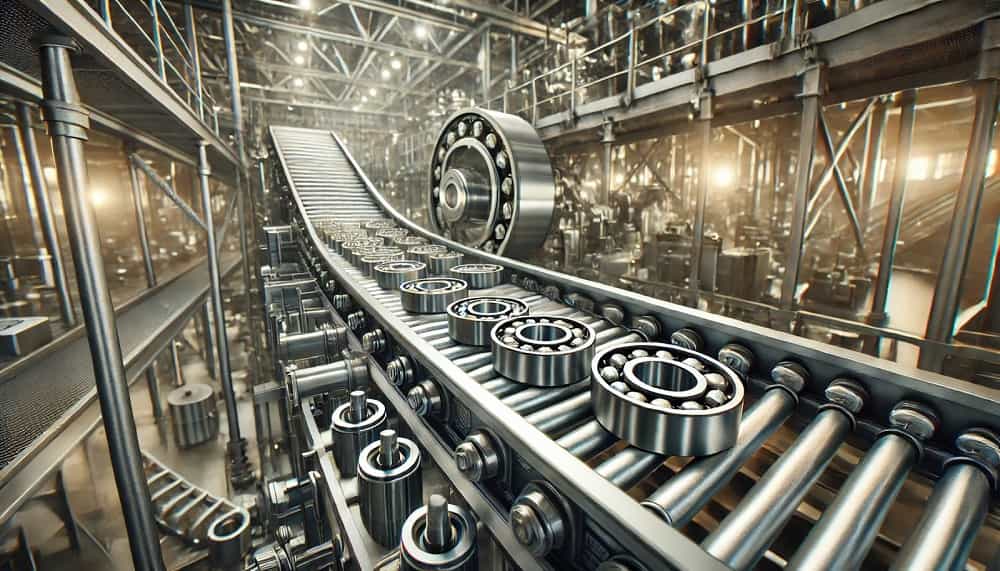
A bearing failure rarely announces itself in advance. It shows up as unexpected vibration on a condition monitoring trend, then as elevated operating temperature, then — if the maintenance window is missed — as a seized shaft, a damaged housing, and a production line down for hours or days while the failed unit is extracted and a replacement is sourced. The cost of that sequence is rarely proportional to the cost of the bearing itself.
A ₹15,000 tapered roller bearing failing in a gearbox driving a production line can generate downtime costs of ₹5–10 lakh per shift in a mid-scale manufacturing facility — a ratio that explains why export quality bearings have moved from a procurement preference to an operational requirement across manufacturing sectors that cannot absorb unplanned downtime.
The term "export quality" is not marketing language when used correctly. It refers to a specific, auditable bundle of material specification, dimensional tolerance, heat treatment control, and quality system certification that international buyers — automotive Tier 1 suppliers, industrial machinery OEMs, and equipment manufacturers across Europe, North America, and Southeast Asia — require before approving a new bearing source. Understanding what that bundle actually contains explains why the gap between export-grade and domestic-grade bearing supply has direct consequences for the manufacturing industries that depend on bearing reliability.
The difference between a standard-grade bearing and an export-grade bearing begins with steel. SAE 52100 / DIN 100Cr6 bearing steel produced through vacuum degassing and calcium treatment achieves oxygen content below 10 ppm and inclusion ratings of A1–B1 on the ASTM E45 worst-field assessment — the cleanliness level required to sustain rolling contact fatigue life at the 2,000–3,500 MPa contact stresses that taper roller bearings experience under rated load. Standard-grade steel without vacuum treatment typically carries oxygen content of 15–25 ppm and inclusion ratings of B2–C2, producing measurably shorter L10 fatigue life under identical load conditions — a difference that does not show up in a dimensional inspection but shows up in field failure data after 8,000–15,000 operating hours.
Dimensional tolerance is the second pillar. ABEC 1 (Normal grade) bearings carry bore tolerances of 0 / -0.012 mm at 50 mm bore diameter. ABEC 3 (P6 grade) tightens that to 0 / -0.010 mm, and ABEC 5 (P5 grade) — specified for precision spindle and high-speed applications — requires 0 / -0.008 mm. Export quality bearings destined for automotive and precision industrial applications are produced to P6 or P5 grade as standard, with Cpk values of 1.33–1.67 on critical dimensions demonstrated through statistical process control data that accompanies the PPAP submission for new part approval — not claimed on a datasheet but proven through 30-piece dimensional studies reviewed by the customer's incoming quality team.
Don’t forget to check out these: AI in Machine Tools & Bearings: Powering Industry 4.0
Heat treatment control is the third pillar, and the one least visible to a buyer inspecting a finished bearing. Surface hardness of 58–64 HRC, retained austenite below 8% for standard grade and below 5% for precision grade, and case depth control within ±0.1 mm for carburized variants are all process outcomes that depend on furnace atmosphere control, quench medium temperature stability, and tempering cycle precision. Export quality bearings carry documented heat treatment records — furnace charge records, hardness test certificates per ASTM E18, and retained austenite measurement by X-ray diffraction on sample rings from each production batch — that link the finished product back to the process that produced it.
A tapered roller bearing exporter supplying to international OEMs operates under a qualification framework that domestic-only suppliers rarely encounter. The qualification cycle for a new bearing source — particularly in automotive supply chains — runs 12–18 months and includes dimensional correlation studies against the existing approved source, dynamic load and life testing referenced to ISO 281 L10 calculations, noise and vibration testing per ISO 15242 across defined frequency bands, and a production PPAP submission demonstrating that the new source's process is statistically capable of holding the specified tolerances across continuous production, not just on first-article samples.
IATF 16949:2016 certification is the non-negotiable baseline for any tapered roller bearing exporter targeting automotive supply. It mandates documented APQP, PFMEA, and control plan processes — meaning that for every bearing part number, the exporter has a documented risk assessment covering 40–80 individual failure modes across material receipt, forging, heat treatment, grinding, and assembly, with detection controls assigned and verified at each process step. Buyers auditing a potential tapered roller bearing exporter review these documents directly, not as a formality but as the primary evidence that the manufacturer understands where its process can fail and has controls in place to catch it before the bearing ships.
Read also: Step-by-Step Manufacturing Process of Pillow Block Bearings
Traceability completes the framework. Every finished bearing must be traceable to its steel heat number, forging lot, heat treatment batch, and grinding batch — a chain that allows a field failure investigation to identify whether a quality issue is isolated to a single production lot or systemic across a material or process change. A tapered roller bearing exporter without this traceability infrastructure cannot support the root cause analysis that international OEMs require when a field issue arises, regardless of how the product performs on the bench.
Industrial bearing manufacturers supplying export-grade product serve a far broader application range than automotive alone. Cement plant kiln support bearings, paper mill roll bearings, steel mill rolling stand bearings, and marine propulsion shaft bearings each impose distinct combinations of load, speed, contamination exposure, and lubrication regime that the bearing design and material specification must address individually rather than through a single catalogue product applied universally.
In industrial machinery bearings applications — gearboxes, conveyor systems, fans, pumps, and compressors across manufacturing plants — the dominant failure modes are contamination ingress and lubrication breakdown rather than pure fatigue. Industrial bearing manufacturers producing export-grade bearings for these applications specify sealing systems validated to ISO 6194-5 dust ingress testing, with triple-lip seal designs maintaining contact pressures of 0.3–0.8 N/mm to exclude particulate in the 20–200 µm range that is abrasive at the rolling contact. A bearing that meets dimensional and material specification but uses a standard single-lip seal in a contaminated industrial environment will fail from contamination-driven wear long before fatigue becomes the limiting factor — which is why export-grade specification extends beyond the bearing's core dimensions into the sealing and lubrication system as an integrated design decision.
Roller bearing manufacturers India have closed the gap between domestic production capability and the specification depth that export markets demand — not uniformly across every producer, but at a tier that has invested in vacuum-treated steel sourcing, IATF 16949 certification, precision grinding infrastructure capable of P5 and P6 tolerance grades, and the testing and documentation systems that PPAP submissions require. That investment changes the cost-quality equation in a specific way: the landed cost of an export-grade bearing from this tier of roller bearing manufacturers India typically runs 20–35% below equivalent European or Japanese product at the same specification, while the field performance — L10 life, dimensional consistency, traceability — meets the same standard those established sources have set for decades.
For manufacturing industries evaluating bearing sourcing decisions, that cost-quality equation is the actual business case for shifting toward roller bearing manufacturers India as a primary or qualified secondary source — not a cost reduction that comes with a quality compromise, but a cost reduction at equivalent specification, achievable because the manufacturing cost base in India for precision grinding, heat treatment, and quality system operation is structurally lower than in the established source geographies, while the steel, process, and certification standards are now equivalent.
Automotive bearing manufacturers operate under the most demanding combination of cost pressure and reliability requirement in the bearing industry — production volumes in the hundreds of thousands of units per part number, warranty exposure that extends to vehicle service life of 150,000–250,000 km, and zero tolerance for the kind of field failure that triggers a recall investigation. The quality systems, statistical process control discipline, and traceability infrastructure that automotive bearing manufacturers have built to meet that standard represent the highest bar in the bearing industry — and the export-grade specification framework described throughout this article is, in large part, the automotive sector's standard extended to industrial and other applications.
Manufacturing industries outside automotive that adopt the same export-grade bearing specification are not over-specifying. They are applying a reliability standard that the automotive sector proved necessary at a scale and cost point that makes it accessible across industrial applications where unplanned downtime costs exceed the marginal price difference between standard-grade and export-grade bearings by orders of magnitude.
The shift toward export-quality bearings across manufacturing industries is not a premiumisation trend driven by marketing. It is a recognition — arriving sector by sector, as downtime costs and reliability expectations rise — that the marginal cost difference between standard-grade and export-grade bearing specification is small relative to the cost of the failure that the export-grade specification prevents. Steel cleanliness, dimensional tolerance, heat treatment control, sealing system design, and traceability infrastructure are not abstract quality attributes. They are the specific, measurable reasons one bearing survives 30,000 operating hours and another fails at 8,000.
A tapered roller bearings exporter that has built the certification, testing, and documentation framework to supply international automotive and industrial OEMs has, by definition, built the framework that any manufacturing industry can rely on. The export market did not create a separate quality standard for bearings. It created the auditing pressure that made the existing engineering standard — the one that was always necessary — into one that is now consistently delivered.