

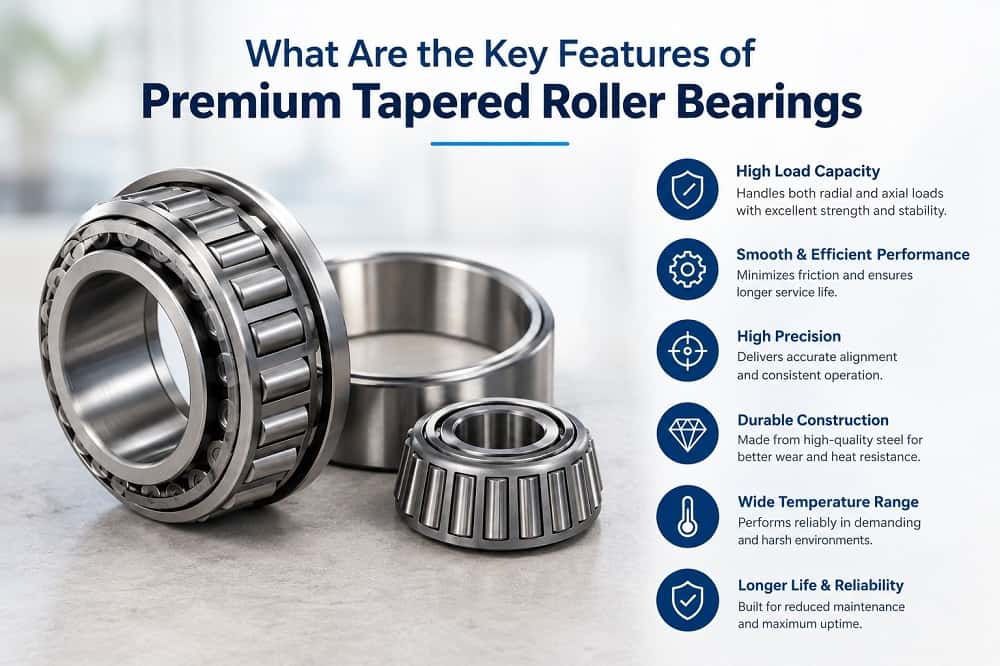
Tapered roller bearings are unique in their capacity to handle simultaneously acting radial and thrust loads. Unlike standard ball bearings, a tapered bearing has rollers that make conical contact with both the inner ring and outer ring. This geometry allows them to carry greater radial loads and higher thrust loads compared to standard bearings. It is a critical component in rotating machinery, where high radial and axial forces are present. As a result, tapered roller bearings are used in gearboxes, rotating machinery, and automotive axle hubs.
However, the choice of the bearing manufacturer plays a vital role in determining its performance characteristics. This article discusses features that differentiate premium quality tapered roller bearings from standard ones, and what to look for in a tapered roller bearings manufacturer.
Tapered roller bearings usually have a pair of rollers that contact both the inner and outer ring. As mentioned, the geometry of these rollers allows them to handle large radial, thrust, and combined loads. It is a critical feature that makes them superior in many applications, including automotive, gearboxes, conveyors, and rolling mills.
The material used, machining accuracy, and heat treatment of the tapered roller bearings also impact their performance significantly. A bearing manufactured by a reputable tapered roller bearing manufacturer will have features that are carefully selected to fulfill the required application.
Most tapered roller bearings are manufactured using chrome steel (SAE 52100) or case-hardened steel. Depending on the desired performance, different bearings have various forging processes. As a result, the material properties vary, and certain bearings can withstand higher stresses and shocks than others.
A reputable tapered roller bearing manufacturer will carefully choose the material composition of the bearings they produce. This is important because the forged material will determine the hardness, fatigue resistance, and overall performance of the finished product.
Machining accuracy is one of the most critical aspects of tapered roller bearing manufacturing. In most cases, the rollers must have specific taper ratios to conform to their rollers. Similarly, the inner and outer rings should have well-defined mating surfaces. If machining tolerances are outside the set specifications, the contact areas will have improper load distribution, decreasing the bearing’s performance and longevity.
It is, therefore, essential to choose a tapered roller bearing manufacturer with the capability to produce bearings with precise machining.
One of the distinguishing features of tapered roller bearings is that they have a contact angle. The contact angle is defined as the angle formed between the rollers and the inner and outer rings. It primarily determines the magnitude of the thrust load that can be carried by the bearing. In other words, a larger contact angle means the bearing can carry higher axial loads.
Different tapered roller bearings have different contact angles depending on their intended use. A good tapered roller bearing manufacturer should be able to recommend the optimal contact angle based on the application.
The heat treatment process of the tapered roller bearings significantly enhances their material properties. Case hardening, through-hardening, and other related heat treatment methods allow manufacturers to improve hardness and increase resistance to impacts and deformation. This is one of the most crucial steps in roller bearing manufacturing since it directly determines the fatigue life of the product.
A tapered roller bearing consists of three main parts: the rollers, inner ring, and outer ring. The cage keeps the rollers separated and maintains the overall geometry of the bearing. Some roller bearings have machined brass cages, while others use stamped steel or polymer cages. The choice of material depends on the size, operating temperature, and rotational speed of the bearing. A good bearing manufacturer will consider these factors and recommend bearings with optimal cage design.
Exposure to moisture and extreme environments can severely shorten the service life of roller bearings. This is especially true for bearings used in the mining and agricultural industries. For this reason, some manufacturers offer special corrosion-resistant bearings with enhanced protection against moisture, dirt, and other damaging elements.
Roller bearings have a smooth surface finish on their contact surfaces. This is important because it affects their friction characteristics and, by extension, the overall performance. Surfaces with a smoother finish usually result in better anti-friction properties, allowing these bearings to operate more efficiently.
Precision manufacturing is key to achieving high-quality tapered roller bearings. Every step in the production process must be carried out under controlled conditions to achieve stable and reliable performance. For example, forging rollers at incorrect temperatures can lead to poor material response, affecting the overall toughness of the finished bearing. Similarly, inaccurate grinding processes can leave defects on the surface of the rollers, adversely affecting performance.
It is, therefore, essential to choose a reliable tapered roller bearing manufacturer with proven expertise in producing high-performance tapered roller bearings.
Premium quality tapered roller bearings have several advantages over standard bearings. The two primary differences are material composition, machining accuracy, and additional performance-enhancing features such as surface finishing. The table below compares some of the most common features of standard roller bearings and premium quality tapered roller bearings.
| Feature | Standard Bearings | Premium Bearings |
|---|---|---|
| Steel Grade | General-purpose alloy steel | High-grade chrome or case-hardened steel |
| Machining Tolerance | Moderate precision | Tight ISO/ABEC-grade precision |
| Heat Treatment | Basic hardening | Controlled case or through-hardening |
| Cage Material | Stamped steel only | Steel, brass, or engineered polymer options |
| Sealing | Minimal or none | Enhanced sealing and corrosion protection |
| Surface Finish | Standard grinding | Superfinished raceways and rollers |
| Load Capacity | Adequate for light-duty use | Suited for heavy and combined loads |
| Service Life | Shorter under continuous stress | Extended operational lifespan |
Tapered roller bearings are used in a wide range of applications, varying from simple rotating machinery to heavy-duty equipment such as mining machinery and rolling mills. In general, the performance requirements of tapered roller bearings are directly proportional to the severity of the operating environment. The most common industries that use tapered roller bearings include:
Tapered roller bearings are used extensively in the automotive industry. They are used in the wheel hub, transmission, and differentials of a vehicle. Their main function is to carry radial and thrust loads from the road and the weight of the vehicle. The automotive industry, therefore, requires bearings that can handle high radial and thrust loads.
Machinery such as rolling mills, gearboxes, and conveyors are subjected to extremely high radial loads. Bearings used in this industry, therefore, need to have a higher load capacity. Additionally, these machines operate almost continuously, meaning that the bearings should also have longer service life.
The construction and mining industries operate in some of the harshest environments. As a result, the equipment used in these industries requires bearings that are resistant to moisture, extreme temperatures, and dirt.
Most agricultural machinery operates under highly variable loading conditions. They also operate under relatively high radial and axial forces, making tapered roller bearings an ideal choice.
In addition to the features discussed above, there are several other factors to consider when choosing a tapered roller bearing manufacturer. First, it is essential to choose a manufacturer that sells bearings that have been tested and approved by independent organizations. This ensures that the manufacturer adheres to standardized manufacturing specifications. Additionally, it is always a good idea to request a test sample to confirm the stated specifications before making a bulk purchase. It also helps to choose a manufacturer that has experience working with bearings of similar ratings and specifications. Some manufacturers also offer customization services and can modify standard bearings to fit specific applications. A reliable manufacturer will also provide detailed documentation about the bearings, including material composition and heat treatment.
DEC Bearings is a bearing manufacturer that offers a wide range of premium-quality tapered roller bearings suitable for various applications. Their tapered roller bearings have a high-quality chrome steel composition and are manufactured using advanced precision machining techniques.
Premium quality tapered roller bearings are characterized by high-quality material composition, machining accuracy, and additional features such as enhanced surface finishing and corrosion resistance. These attributes enable them to handle demanding applications such as heavy-duty rotating machinery, mining equipment, and automotive axle hubs. Choosing the right tapered roller bearing manufacturer will ultimately determine the efficiency and longevity of the equipment. A reliable manufacturer will also guarantee stable performance of the bearings throughout their service life.